Islamic wedding cards lead with khat script, geometric pattern and a calm palette rather than photographs of the couple or heavy ornament. They suit couples who want the card to carry a devotional tone rather than only a celebratory one — right for an akad nikah, a walimatulurus, or a thanksgiving kenduri meant to stay restrained but dignified.
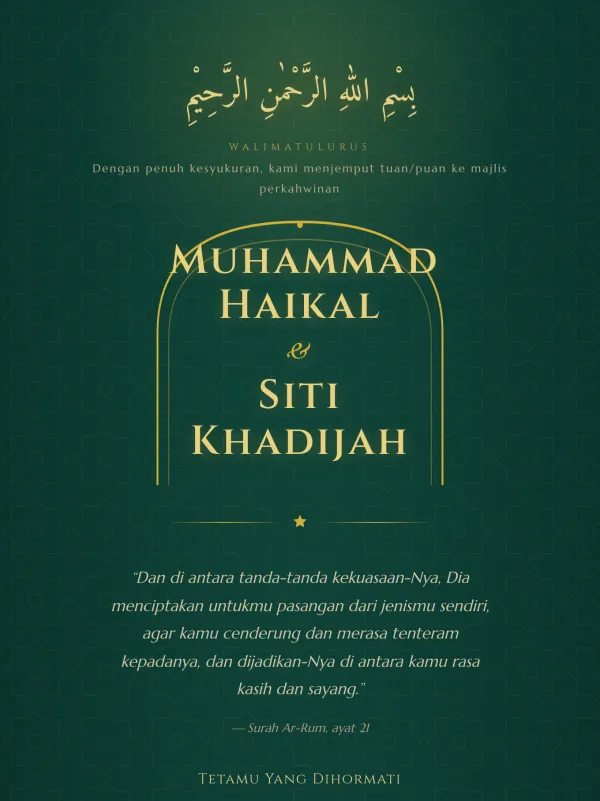
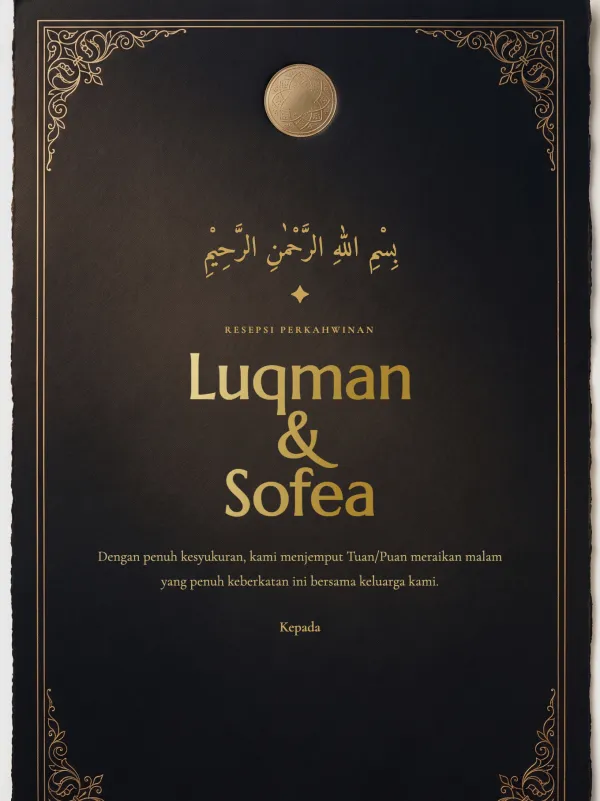
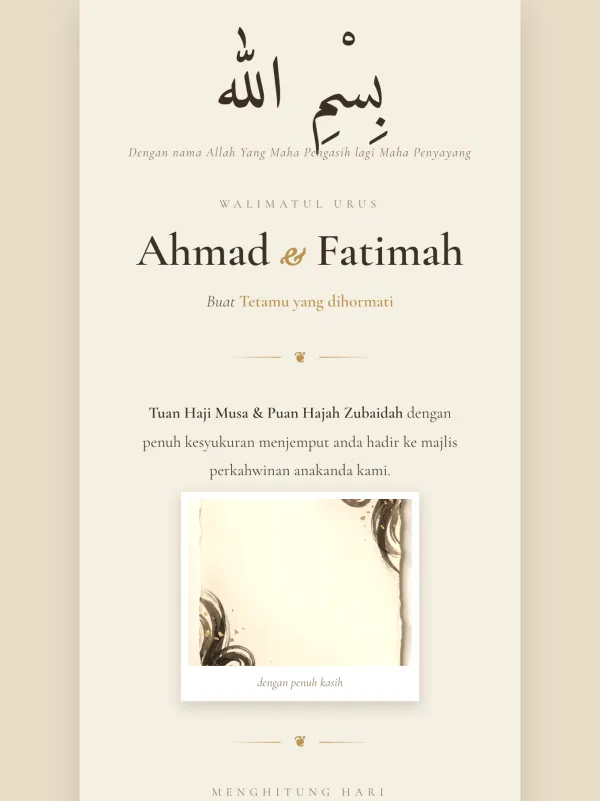
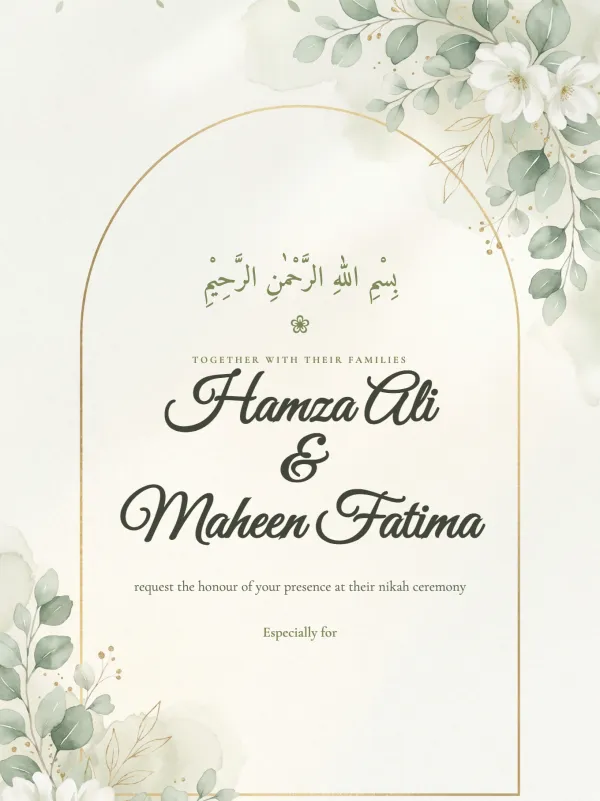
Three things separate an Islamic wedding card from a classic or modern one: khat script as the main visual element, geometric or arabesque pattern in place of figurative imagery, and a lowered palette — olive green, old gold, cream, sage and onyx.
Islamic cards also tend to leave the couple's photograph off the cover. That is a design choice rather than an absolute rule, but it is why cards in this style rely on typography and texture to create their effect — and why they stay beautiful even when very plain.
Khat in thuluth, diwani or naskh as a heading, or a bismillah across the top of the card.
Repeating geometric and arabesque pattern forming a frame, with no figurative imagery.
A lowered palette: green, old gold, cream, sage, onyx. Rarely fully saturated colour.
Open space — generous distance between elements so the card feels calm rather than crowded.
One short dua in place of a long welcome passage.
Four Islamic styles in our catalogue
The four examples above cover the variations chosen most often. Nur is the plainest, usually picked for a small akad nikah that wants the card to stay quiet. Khat Emas Onyx sets gold khat on deep onyx, formal enough for a walimah in a hall. Kaligrafi Sepia runs warm sepia and reads like an heirloom card kept for years. Nikah Sage Air pairs sage with watercolour, which suits a daytime event in a garden or at home.
Common duas and wording on a nikah card
Most Islamic cards open with the bismillah, then a short dua for the couple. The most common in Malaysia is "barakallahu lakuma wa baraka alaikuma wa jamaa bainakuma fi khair" — may Allah bless you both and unite you in goodness.
Resist filling the card with passages. A card carrying one dua with open space around it lands better than one packing three quotations into small type. If you want more ready-made wording — Islamic, formal and short versions — we keep a separate page full of examples.
Digital vs printed Islamic cards
Printed Islamic cards often use gold foil and heavy stock to do justice to the khat — and that is what drives the cost up. A digital version keeps the script sharp on screen without the foil cost, and can be updated if the akad date moves.
Digital Islamic card
Printed Islamic card
Cost
From RM10, one-off
RM900–RM2,400 for 300 guests with gold foil
Turnaround
Same day
1–3 weeks including foil printing
Sharpness of the khat
Stays sharp on any screen
Depends on print and paper quality
Changing the akad date
Edit; the link stays the same
Reprint the whole run
RSVP
Built into the card
A separate form or phone calls
For older relatives
Has to be opened on a phone
Can be held and kept
FAQ about Islamic wedding cards
What is the difference between an Islamic and a classic wedding card?
Classic cards lean on Malay woven motifs — songket, batik and gold carving — with deep palettes such as maroon and black. Islamic cards lean on khat, geometric pattern and a calmer palette of green, sage and cream, and usually leave figurative imagery off the cover.
Can I put photographs of the couple on an Islamic card?
You can — it is your choice, not a platform restriction. That said, most couples choosing this style leave faces off the cover and place event photographs in the gallery further down the card.
What wording suits an Islamic nikah card?
The most common is the bismillah followed by "barakallahu lakuma wa baraka alaikuma wa jamaa bainakuma fi khair". One dua with open space around it works better than several quotations in small type. Our wedding card wording page has Islamic examples you can copy directly.
Is this style only for the akad, or for the walimah too?
Both. The same design can carry a morning akad nikah and an evening walimah programme on one card, so guests do not need two cards for one day.
Are Islamic designs more expensive?
No. Every design in the catalogue sits at the same price — from RM10 one-off — including those carrying khat and calligraphy.
Can I change the colours of an Islamic card?
Each design's core colours are fixed so the khat and pattern stay balanced, but you can choose between several Islamic designs with different palettes — onyx, sepia, sage and cream — to match your event's theme.